
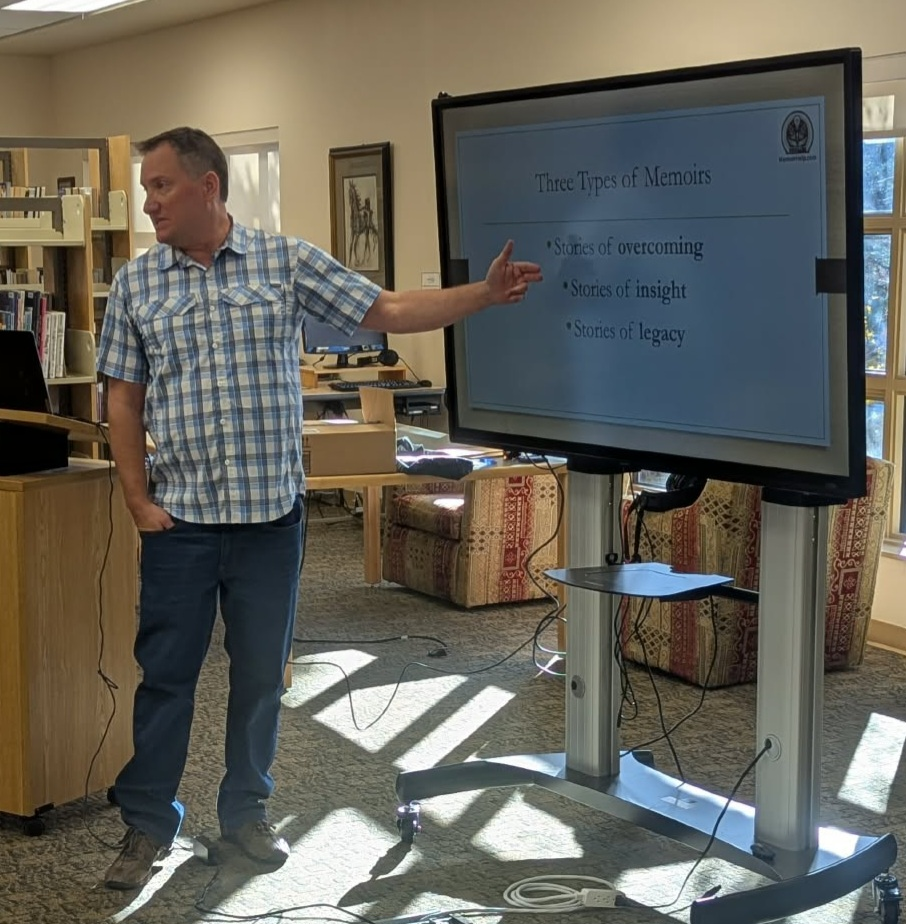
I recently gave a talk at the library in Claresholm, Alberta, about writing family memoirs. During the Q&A, a woman asked me a great question:
“What’s the most challenging part of writing a family memoir?”
I told her that, in my experience, the biggest challenge is usually deciding on a structure.
Most family memoirs are chronological, which makes sense, since our lives unfold in time. But if your book is just “this happened, then this, then this,” it can start to feel a bit flat. Ironically, that straightforward approach can actually make the story harder to follow.
A strong memoir is usually organized around themes. The chapters might still follow the rough order of your life, but there’s a thread running through—a way to make the events feel connected and meaningful. Think of the theme as a prism that helps readers see the deeper colours in your story, or a mental hook to hang your memories on.
Common memoir themes include:
- Overcoming challenges
- Searching for identity
- Adjusting to change
- Developing potential
These themes don’t have to be obvious or explicitly stated. In a family memoir, they’re often subtle—woven into the storytelling. The main goal, after all, is legacy: letting your descendants know where they came from, what kind of life you led, and the values that guided you.
When I ghostwrite a family memoir, I typically use a hybrid chronological/thematic approach. The book usually begins with childhood memories or stories about ancestors. But later, certain chapters might focus on specific topics like travel, values, or career milestones.
That doesn’t mean those topics never appear elsewhere, they just get a dedicated space, which makes the book more cohesive and easier to digest.
Interestingly, the key themes often don’t reveal themselves right away. Whether I’m ghostwriting for a client or someone is writing their own memoir, the themes tend to emerge as the stories unfold. After several hours of interviews (or pages of writing), the patterns become clear.
Memoir writing isn’t just about revealing yourself, it’s also about discovering yourself. And that’s what makes it such a rewarding process for both writer and reader.